
The power of Slide 0: How to align stakeholders before you start your deck
Most confusing decks don’t become messy on the slides. They become messy before the first slide is ever made.
Because the real problem isn’t necessarily the fonts, formatting, or structure. It’s misalignment: Too many objectives. Too many opinions. Too many “quick thoughts” dropped in at the last minute. And absolutely no shared understanding of what the deck is supposed to do.
This is where Slide 0 comes in.
Slide 0 isn’t a slide. It’s the 10–15 minutes of alignment before you open Google Slides or PowerPoint. And it’s a big factor in whether your deck becomes crisp and persuasive or a complete Frankenstein.
What is Slide 0?
Slide 0 is the pre-work: the guardrails that define the story before you try to tell it.
It’s three simple questions:
Who are we talking to and what do they care about?
A CEO and a Head of Product are not the same audience.
What decision or action do we want from this audience?
“Inform them” is never the answer.
What’s the one message we want them to walk away with?
Not three. Not seven. One.
If you can answer these cleanly, your deck practically builds itself. If you skip them, enjoy your revisions (plural).
Why Slide 0 saves you hours (and your sanity)
It eliminates drive-by edits
When stakeholders align upfront, people stop parachuting in later with contradictory comments.
It prevents scope creep
If the story is agreed upon, you don’t suddenly end up “just adding a few slides” that double the deck length.
It forces clarity early
Most presentation pain comes from unclear purpose. Slide 0 fixes that.
What Slide 0 looks like
Here’s a simple Slide 0 template you can use as a guide before you build anything. Share it. Confirm alignment. Then, and only then, start building.
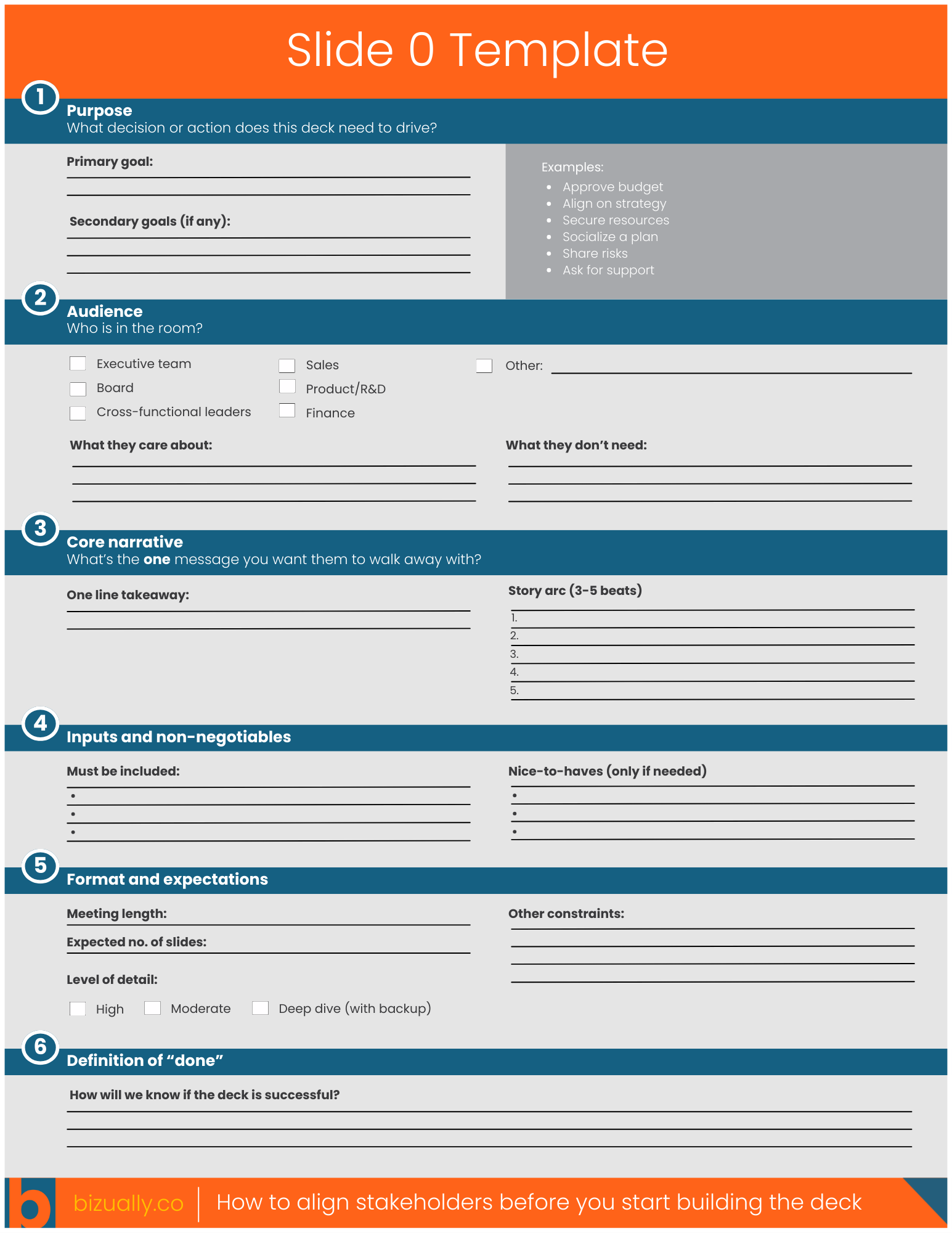
The template covers five important areas:
Purpose: What’s the decision/action this deck needs to drive?
Audience: Who’s in the room? What do they care about? What do they not care about?
Core Narrative: What is the one-line takeaway? What’s the story arc?
Inputs: What must be included? What is optional?
Format: Length expectations, time allotted, level of detail.
Slide 0 in action
Some common scenarios may include:
Leadership update: Align on whether the deck is for decision-making or simply visibility (they are not the same)
Board meeting: Decide the 2–3 strategic messages that matter. Everything else becomes backup.
Go-to-market plan: Agree on who the plan is for—sales, execs, or cross-functional teams. The story changes depending on the audience.
Quarterly updates: Clarify whether you’re reporting progress, escalating risks, or pitching a new direction.
Slide 0 is where clarity happens. And clarity is what makes decks shorter, stronger, and easier to approve. So before you spend hours designing layouts or writing headlines, align on Slide 0. Because the fastest way to fix a messy deck is to prevent one.
